A modern sports helmet protects the head by doing two things at once: it spreads an impact force over a wider area, and it stretches the collision out in time so the head decelerates more gradually. The hard outer shell handles the first job; the energy-absorbing foam liner handles the second. Together, they reduce the acceleration of the head during impact, which in turn reduces the brain's collision with the inside of the skull and the sudden deceleration that can injure nerve fibers. The specific materials chosen—particularly advanced polyurethane foams with properties like low rebound and viscoelasticity—determine how well that system performs.
The Biomechanics of Head Protection
Injury biomechanics, the field that underpins helmet design, works backward from the injury itself. The Virginia Tech Helmet Lab describes its approach this way: "Rather than studying how to treat injury, we explore ways to prevent injury." That research involves identifying injury mechanisms, quantifying the biomechanical response to impact, determining tolerance levels, and evaluating protective design, with a primary focus on concussion.
The core insight is that brain injury from a collision is largely a problem of acceleration. A review of sport-related concussion equipment published through the National Center for Biotechnology Information explains that protective headgear "decrease[s] the potential for severe TBI following a collision by reducing the acceleration of the head upon impact, thereby decreasing both the brain-skull collision, as well as the sudden deceleration induced axonal injury." In other words, the helmet's job is not to stop the head—that is physically impossible in a fast collision—but to slow the change in velocity so the forces stay below the thresholds at which brain tissue is damaged.
That same review notes an important boundary: while helmets are well established at reducing severe traumatic brain injury, their specific effects on concussion incidence and severity are less clear. This article focuses on the impact-absorption mechanism itself, not on certification standards or on neck and other injury types.
Layer by Layer: How a Modern Helmet Works
Modern helmets are built from multiple layers of materials—energy-absorbing foams, plastics, and gels—designed, as the engineering consultancy Exponent describes, "to deflect, absorb, and distribute forces during impact, slowing down the forces transferred to the head and brain." Each layer has a distinct role, and the system only works when they act together.
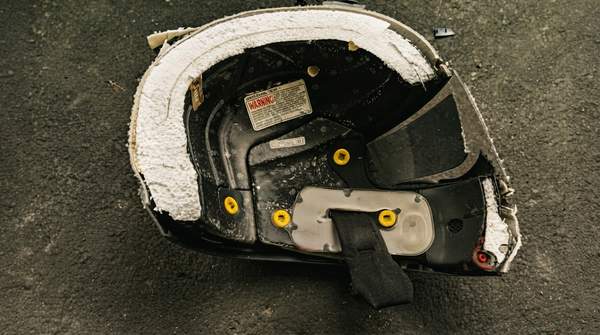
The hard outer shell is the first point of contact. Its function is to deflect the impact and distribute the force across a larger area of the head, so no single spot absorbs the full concentrated load. Beneath it sits the energy-absorbing liner, typically a foam, which compresses during the collision to absorb force and then slowly restores toward its original shape. This compression is what buys the head time: by deforming, the liner extends the duration of the impact, lowering the peak acceleration the brain experiences.
The third element is the fit system. Football helmet designs illustrate how much engineering goes into keeping the helmet stable—manufacturers use inflatable vinyl bladders, halo-style tubular air systems, and cable-tightened "shock bonnets" to hold padding firmly against the head. Fit is not a comfort afterthought: if the helmet shifts during impact, the shell and liner cannot stay correctly positioned to distribute and absorb force.