Compression gear's strongest, most consistent benefit is helping you recover after exercise—not making you faster while you wear it. That single distinction, echoed across sports science reviews and medical guidance alike, should anchor any purchase. The four main athletic garment types—socks, sleeves, tights and shorts, and shirts—target different body regions and different problems, so the right choice depends on where you hurt, swell, or need support, not on the boldest claim on the packaging.
Understanding Compression: Medical vs. Athletic Applications
Compression therapy began in medicine, not sport. Cleveland Clinic describes its core advantages: improving blood circulation in the legs, reducing pain and swelling, healing ulcers caused by blood pooling, managing conditions such as chronic venous insufficiency and orthostatic hypotension, and helping prevent deep vein thrombosis. Athletic compression borrows these same mechanisms—pushing pooled fluid and blood away from an area—and points them at exercise-induced soreness and fatigue.
UPMC's health guidance explains the swelling mechanism in plain terms: compression keeps fluid inside your capillaries and out of surrounding tissue, which is why doctors sometimes recommend it for edema or lymphedema. Sports science writers such as Dr. Tom Brownlee, writing for Science for Sport, note that this medical heritage is precisely why recovery claims sit on "more solid ground" than performance claims.
That performance skepticism is shared across sources. A 2022 systematic review and meta-analysis published through PMC found that when worn during rest intervals of one to twenty-four hours after fatiguing exercise, compression garments significantly mitigated the decline in muscle strength—and the authors proposed mechanisms including reduced inflammatory response in muscles, minimized muscle sway, maintained body surface temperature, and pressure-activated proprioception. Yet a Science for Sport review of the broader literature cautions that the research base is "of low quality and riddled with large inconsistencies," meaning findings should be accepted with caution.
Compression Socks: Targeting Lower Leg Recovery and Circulation
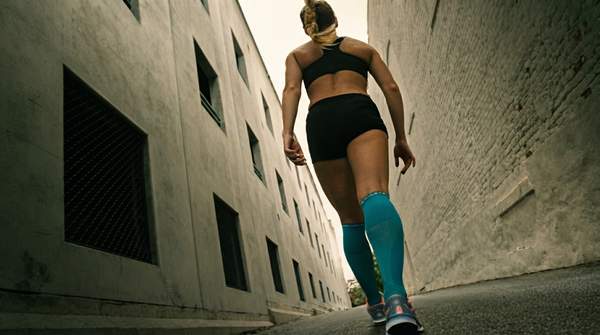
Compression socks cover the foot, ankle, and lower leg, extending to the knee or thigh. Their common uses span both worlds: tired, achy legs from long hours standing; mild swelling; mild varicose veins; travel-associated swelling; and, for athletes, post-activity muscle soreness and recovery. Pinnacle Vitality Rehab notes their practical appeal—they are easier to put on than full stockings and come in athletic, casual, and dress styles.
The recovery evidence for socks and similar lower-body garments is among the most consistent in the field. Research cited by BioSkin attributes measurable reductions in muscle soreness and accelerated functional recovery to 24 hours of post-exercise compression use, alongside faster elimination of metabolic byproducts such as lactic acid. Compression worn after exercise, in other words, has a clearer physiological story than compression worn during it.
What socks do not clearly do is make you faster in the moment. Anderson Powerlifting's overview is blunt that wearing compression garments has no demonstrated impact on runners' speed or endurance, and UPMC similarly reports no solid research behind performance-enhancement claims. If your goal is heavy, tired calves after a long run or a long shift, socks are the targeted tool; if your goal is a personal best, the evidence will not carry that weight.
Compression Sleeves: Focused Support for Arms and Calves
Sleeves are the most surgical option in the lineup. Available as calf, arm, elbow, and knee versions, they deliver targeted compression without covering the foot or hand—which matters if you want ankle mobility bare or need grip unhindered. Clinically, sleeves are used for lymphedema in the arms or legs, tendonitis, joint support, and swelling from overuse or repetitive strain; athletically, runners, weightlifters, and rehabilitation patients use them for muscle soreness and recovery.
The mechanism for a sleeve is the same as for any compression garment: externally squeezing the limb to reduce oscillation, support tissue, and encourage fluid movement. The meta-analysis evidence on post-exercise strength recovery applies here as it does elsewhere, and the proprioceptive pathway the PMC review highlights—pressure activating limb awareness—gives sleeves a plausible role in joint-awareness-dependent activities. Because a sleeve concentrates pressure on one segment, it is the natural choice when your problem is one calf, one elbow, or one achy arm rather than a whole limb system.
Compression Tights and Shorts: Lower Body Performance and Recovery
Tights and shorts are the workhorses of compression apparel—Sportsmith describes leg-covering tights as the most common garments in the research literature. Longer versions support the calf muscles, glutes, groin, and quadriceps, making them the broadest lower-body option. Athletes reach for them primarily to reduce post-exercise soreness and fatigue across large muscle groups, the same recovery pathway supported by the strength-recovery meta-analysis.
One caution belongs here. Sportsmith points out that some research has suggested improved recovery with compression garments while failing to show any actual change in physical function after exercise—perceived recovery and measured recovery are not the same thing. Tights also carry mixed secondary claims: Anderson Powerlifting credits them with reducing chafing and, tentatively, supporting joints and ligaments in ways that might improve posture and reduce muscle strain, while explicitly flagging the research as mixed and not definitive. For a hard leg session or a marathon, tights are the region-appropriate recovery pick; just weigh the feel-good effect alongside the functional data.
Compression Shirts: Upper Body Support and Recovery
Shirts complete the four-type framework by covering the chest and arms, and Sportsmith notes that compression garments covering the arms, chest, and even the entire body appear regularly in the literature. The evidence specific to shirts is thinner than for lower-body garments, so treat them as the same mechanisms applied above the waist rather than a separately proven category.
The claimed upper-body effects are plausible extensions of the same physiology. Anderson Powerlifting suggests shirts improve blood flow across the upper body, lessen arm muscle oscillation, and help realign posture in sports demanding unnatural positions, such as cycling and skiing, while also keeping the torso warm in cold or early-morning training. The PMC meta-analysis's proposed mechanisms—reduced inflammation, minimized muscle sway, maintained temperature, and pressure-stimulated proprioception—map reasonably onto these uses. If your soreness lives in your shoulders, chest, or arms, a shirt is the only garment in this set that addresses it.
Compression Gear Comparison: Find Your Fit
The table below maps each garment type to the body area it covers, its most evidence-supported application, and where its performance claims stand. Use it to move from "I want compression gear" to "I want this garment for this problem."
| Gear Type | Primary Target Area | Primary Use Case (Recovery/Support) | Notes on Performance Claims |
|---|---|---|---|
| Compression socks | Feet, ankles, and lower legs, to the knee or thigh | Improving circulation, reducing swelling, and aiding lower-leg recovery; also used medically for varicose veins and travel swelling | Recovery evidence is stronger than performance evidence; research suggests no impact on running speed or endurance |
| Compression sleeves (arm/calf) | A single limb segment—calf, arm, elbow, or knee—without covering the foot or hand | Localized muscle and joint support, reduced soreness, and recovery; also used for tendonitis, lymphedema, and overuse swelling | May mitigate post-exercise strength decline during 1–24 hour rest intervals; mechanism includes reduced muscle oscillation and improved proprioception |
| Compression tights/shorts | Hips, glutes, groin, quadriceps, and calves | Reducing soreness and fatigue across large lower-body muscle groups; possible joint and ligament support | Encouraging recovery findings, but some studies show perceived recovery without measured functional change; posture and joint-support research is mixed |
| Compression shirts | Chest and arms; sometimes extended to the full upper body | Upper-body blood flow, reduced arm muscle oscillation, warmth, and posture support in sports like cycling and skiing | Less garment-specific evidence than lower-body options; claims extend the general compression mechanisms rather than resting on shirt-specific studies |
Choosing Your Compression Gear: A Practical Decision
Select compression gear based on your specific recovery or support needs for a targeted body part, prioritizing evidence-backed recovery benefits over less substantiated performance enhancement claims. The reader can identify a specific type of compression gear—calf sleeves for calf soreness, socks for swollen lower legs after a long shift or a marathon, tights for quad and glute recovery after heavy lifting—that aligns with their post-exercise recovery or support goals, rather than selecting based on general performance promises.
Two boundaries matter before you buy. Pressure levels are not interchangeable: UPMC notes everyday athletic wear provides less compression than medical-grade garments, which run from 20–40 mmHg up to a prescription-required 40–50 mmHg—and your doctor should specify medical types and pressures. And anyone with conditions such as deep vein thrombosis, varicose veins, or lymphedema should consult a physician before using compression gear, since Cleveland Clinic lists skin irritation and discomfort among its possible risks even in therapeutic use.
A simple check closes the loop: name the body region and the goal—recovery, swelling, or joint support—before naming a product. If a garment's promise is speed or endurance during activity, the current research does not back it; if its promise is less soreness and better-functioning muscles the next day, that is where the evidence actually lives.
Sources
- Compression Therapy: Types and Benefits — Cleveland Clinic
- Compression Clothing and Circulation Benefits — UPMC | Life Changing Medicine
- Effects of Compression Garments on Muscle Strength and Power Recovery Post-Exercise — PMC
- Compression garments: Do they actually work? — Science for Sport
- Compression Wear 101 — Pinnacle Vitality Rehab
- Compression Therapy for Athletic Performance & Recovery — BioSkin LLC
- Compression Gear: Types, Key Pros & Cons — Anderson Powerlifting
- Compression garments: Just placebo? - Sportsmith