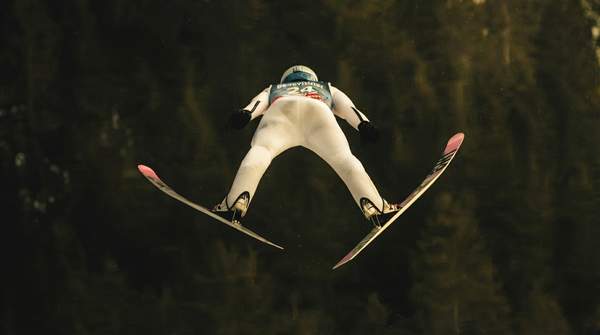
High-performance sports equipment is engineered around a single physical question: should the design fight the fluid, or harness it? In sports such as cycling, where races are decided by fractions of a second, the entire goal is to minimize the drag that air exerts on the athlete. In ski jumping, by contrast, drag is only half the story—the athlete also needs lift, and performance depends on balancing the two. Understanding this distinction explains why a time-trial helmet and a ski jumper's V-position look nothing alike, even though both are solutions to the same physics.
Minimizing Drag for Speed
Drag is the resistive force a fluid—air or water—exerts on a body moving through it. TU Delft's aerodynamics researchers, who study sports applications directly, note that many professional sports such as cycling, ice skating and bobsleigh involve high speeds and are regularly won by fractions of a second. In these sports, a small reduction in aerodynamic drag has direct consequences on the athlete's race time. That is why engineers and athletes obsess over equipment shape, materials and posture: every gram of avoided resistance translates into time on the clock.
The practical expression of this principle is visible in how a cyclist configures themselves for a race. In a Virginia Tech engineering conversation on fluid dynamics in sports, a professor who is also a former college swimmer and current triathlete described the bike leg of a triathlon as a balance between how much power you can put into the pedals and how aerodynamic you can make your bike, your equipment and your body position. The rider's tucked posture is not a stylistic choice; it is a deliberate attempt to present the smallest, smoothest possible shape to the oncoming air, so that more of the athlete's power becomes forward motion rather than a fight against drag.
The same logic applies in water, where the fluid is far denser and resistance correspondingly harder to escape. Hydrodynamic drag is the main resistive force a swimmer faces, and reducing it pays a double dividend. As the Virginia Tech discussion explained, a swimmer who drafts behind another swimmer can go faster than they could alone at the same effort—or, swimming at the same speed against a reduced effective resistance, can lower their effort and save energy for the later bike and run stages of a race. Drag reduction in swimming is therefore not only about speed in the moment but about managing a budget of effort across an entire event.