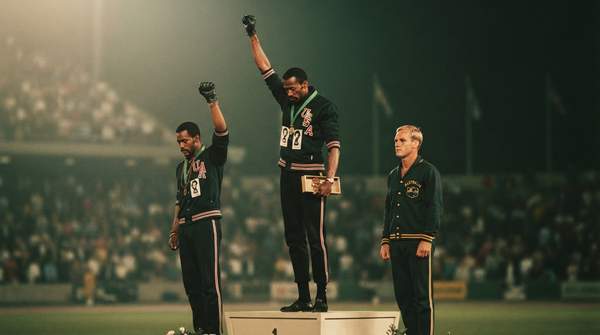
The International Olympic Committee's ban on athlete protest, now known as Rule 50, was not written in a vacuum. Its basic structure entered the Olympic Charter in 1975, seven years after Tommie Smith and John Carlos raised black-gloved fists on the Mexico City podium, and its wording has been repeatedly revised in response to athlete activism ever since. The most recent shift came before the Tokyo Games, when the IOC relaxed enforcement to permit some expression before competition while keeping the podium and ceremonies off limits. Understanding the rule today means understanding the sequence of provocation and codification that produced it.
The Genesis of Olympic Protest Rules: The 1968 Mexico City Games
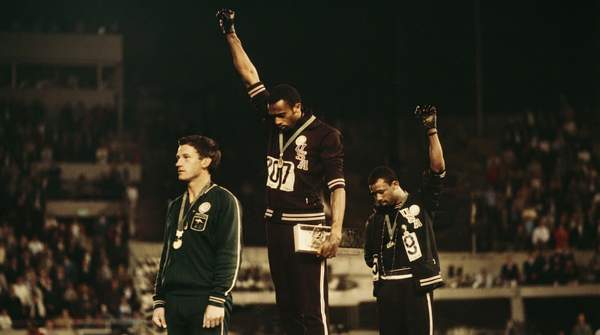
The pivotal moment arrived on the 200-meters medal podium in Mexico City in 1968. American sprinters Tommie Smith and John Carlos raised their black-gloved fists while their national anthem played. As Associated Press national writer Eddie Pells recounts, the two were sent home for disregarding the ban on demonstrations and were ostracized from the Olympic movement for nearly half a century — the U.S. Olympic Committee did not bring them to an official event until 2016, and did not induct them into its hall of fame until 2019.
The IOC's reaction under president Avery Brundage was severe. Historians Debbie Sharnak and Yannick Kluch note that Brundage, who throughout his tenure clung to the idea of an apolitical Olympic arena, considered the protest a violation of the Olympic spirit. The gesture, made during the anthem on the podium, was treated as an intolerable breach of the Games' supposed neutrality — even though the formal Charter language that would define such breaches for decades did not yet exist in its modern form.
Brundage's commitment to an apolitical arena predated 1968. Sharnak and Kluch trace it to the 1955 Olympic Charter, when, immediately upon taking over the presidency, he amended the bylaws to require that potential host cities "must state that no political demonstrations will be held in the stadium or other sport grounds, or in the Olympic Village, during the Games, and that it is not the intention to use the Games for any other purpose than for the advancement of the Olympic Movement." The apparatus for suppressing protest was already in place; 1968 supplied the image that made its expansion inevitable.
Formalizing Prohibitions: The 1975 Olympic Charter and Rule 50's Predecessor
The direct ancestor of Rule 50 arrived in 1975. As Pells reports, the basic structure of the rule was written into the Olympic Charter that year, when it formed part of Rule 55: "Every kind of demonstration or propaganda, whether political, religious or racial, in the Olympic areas is forbidden." Teen Vogue's account of the same history confirms the wording and its 1975 introduction.
The timing and the expanded scope are telling. TIME's reporting on the rule's history notes that the language broadened the parameters of restricted demonstrations to include racial as well as political acts of protest — a change that has been interpreted as a response to Black athletes who used the 1968 and 1972 Games to promote messages of racial justice. Sharnak and Kluch likewise describe the 1975 Charter as the most direct origin of what we know today as Rule 50, with its lineage in the protests and upheavals of the late 1960s.
Notably, the IOC had not always felt the need to codify such a rule. Teen Vogue points to 1956, when Hungary's water polo captain Dezső Gyarmati refused to shake the hand of his Soviet counterpart after the suppression of the Hungarian Revolution, and the IOC felt no need to codify an anti-demonstration rule. The 1975 text formalized what had previously been enforced ad hoc — and it did so in terms broad enough to capture nearly any act of expression an athlete might attempt inside Olympic areas.
Evolving Language: Rule 50 Through the Decades
Once codified, the prohibition was refined and rewritten repeatedly. The provision migrated from Rule 55 to Rule 50, and its wording shifted in ways that reveal the IOC's evolving self-presentation. Sharnak and Kluch highlight one such change: in 1991, the language shifted from "forbidden" to "not permitted" — a softening of tone that left the substance of the ban intact.
The current Charter text, quoted in the official Olympic Charter, reads: "No kind of demonstration or political, religious or racial propaganda is permitted in any Olympic sites, venues or other areas." The structure of the 1975 rule survives intact — demonstrations and propaganda, across political, religious and racial categories, banned across Olympic spaces — but the imperative "is forbidden" has given way to the more bureaucratic "is permitted," inverted into a negation.
Scholarly analysis of this lineage is not flattering. Csilla Szomolaiová, writing in Access to Justice in Eastern Europe, argues that the current legal formulation of Rule 50.2 and its associated expression guidelines is legally ambiguous and enables highly subjective decision-making. The decades of revision, in other words, have not resolved the rule's core tension: it promises neutrality while leaving enormous discretion in the hands of those who interpret it.
Timeline: Athlete Activism and the Evolution of Olympic Rule 50
The chronology below sequences the documented protest moments and the Charter changes that followed them, making visible the reactive pattern in the IOC's regulatory stance.
| Year/Era | Key Athlete Protest(s) | IOC Rule Status/Change | Stated Rationale/Context |
|---|---|---|---|
| 1955 | — | Brundage amends Charter bylaws: host cities must state no political demonstrations will be held in the stadium, sport grounds or Olympic Village. | Brundage's pursuit of an apolitical Olympic arena. |
| 1968, Mexico City | Smith and Carlos raise black-gloved fists during the anthem on the 200m podium. | No new Charter text; the two are expelled from the Games under the existing ban on demonstrations. | Brundage treats the protest as a violation of the Olympic spirit; the athletes are ostracized for decades. |
| 1975 | Aftermath of 1968 and 1972 athlete protests for racial justice. | Charter updated — initially Rule 55: "Every kind of demonstration or propaganda, whether political, religious or racial, in the Olympic areas is forbidden." | Interpreted as a response to Black athletes' racial-justice messaging; aimed at maintaining Olympic neutrality. |
| 1991 | — | Wording shifts from "forbidden" to "not permitted." | Refinement of tone; substance of the ban unchanged. |
| Current Charter | — | Rule 50.2: "No kind of demonstration or political, religious or racial propaganda is permitted in any Olympic sites, venues or other areas." | Official Charter text; critics call it legally ambiguous and open to subjective enforcement. |
| 2021, Tokyo Games | New wave of athlete activism against racial discrimination; some NOCs back athletes' demands. | IOC relaxes application of Rule 50: expression permitted before competition starts and in interviews and meetings; podium and ceremonies remain restricted. | Response to mounting pressure for athlete freedom of expression; neutrality preserved at ceremonial moments. |
Read as a sequence, the pattern is clear: each tightening of the rule followed athlete expression the IOC could not control, and the single documented loosening followed athlete mobilization the IOC could not ignore.
The Modern Stance: Rule 50 and the 2021 Relaxation
The Tokyo Games marked the first significant retreat. Jörg Krieger, writing on the Verfassungsblog, describes how independent athlete organizations and countless individual athletes engaged in a new wave of activism and protest against racial discrimination, with some national Olympic committees supporting their demand to allow certain forms of human-rights protest. In response, the IOC relaxed its application of Rule 50 at the Tokyo Games, allowing free speech in interviews and meetings and opening a possibility for athletes to make political statements.
As Pells reports, the IOC's latest tweak allowed some demonstrations but only "prior to the start of competitions" and not on the medals podium. The IOC also gave discretion to the international federations that run the individual sports on how — and whether — to enforce the bans. This delegation matters: enforcement is no longer a single monolithic process but a patchwork of sport-by-sport decisions.
One clarification of authority is important. The current Rule 50 guidelines were developed by the IOC Athletes' Commission, but the binding authority over Rule 50 rests with the IOC Executive Board — the Athletes' Commission's guidance shapes practice without being the ultimate legal authority for enforcement.
Boundaries of Expression: What Remains Prohibited Under Rule 50
The relaxation has limits, and they fall precisely where the rule's history began. Prohibitions for the sporting arena during competition and during the ceremonies remained in place at Tokyo, as Krieger notes. The podium — the stage on which Smith and Carlos made history in 1968 — remains closed.
The guidelines developed by the IOC Athletes' Commission give what TIME describes as a "non-exhaustive list" of actions that could constitute prohibited protests: displaying political messaging, including signs or armbands; "gestures of a political nature, like a hand gesture or kneeling"; and "refusal to follow the Ceremonies protocol." The intent behind Rule 50, as the Olympic and Paralympic Analysis site summarizes, is to preserve the neutrality of the Games and keep the focus on sport rather than political or social issues.
Whether that neutrality is achievable — or coherently defined — remains contested. Szomolaiová argues that each controversy over athlete expression has raised legitimate concerns about the Olympic Movement's ability to maintain its universal and inclusive character, and that the rule's ambiguity invites inconsistent, subjective decisions. The IOC's own history suggests the boundary it polices has always been drawn in reaction to athletes, not ahead of them.
Navigating Expression: The Enduring Tension of Rule 50
Athletes planning to express views at the Olympics must understand the specific, evolving boundaries of Rule 50, particularly the distinction between permitted pre-competition expression and prohibited actions on the podium or during ceremonies. The rule's five-decade history shows that its meaning has never been fixed: it was created in response to racial-justice protest in 1968 and 1972, softened in wording in 1991, and partially relaxed under athlete pressure in 2021. The measurable indicator to watch is the IOC's official guidelines for upcoming Olympic Games, specifically any updates or clarifications to Rule 50 and its enforcement. When the next revision arrives, it will almost certainly bear the fingerprints of whatever athletes did — or tried to do — on the podium before it.
Sources
- What to Know About the Olympic Political Speech Restrictions — TIME
- Rule 50 and Racial Justice: The Long History of the IOC War on Athletes' Free Expression — HNN
- It’s Insulting to Forbid Olympic Athletes From Protesting — Teen Vogue
- Stillmed
- Keeping Politics Out — Verfassungsblog
- Beyond the podium — Olympicanalysis
- ATHLETES’ FREEDOM OF EXPRESSION AND THE PRINCIPLE OF OLYMPIC NEUTRALITY — Access to Justice in Eastern Europe