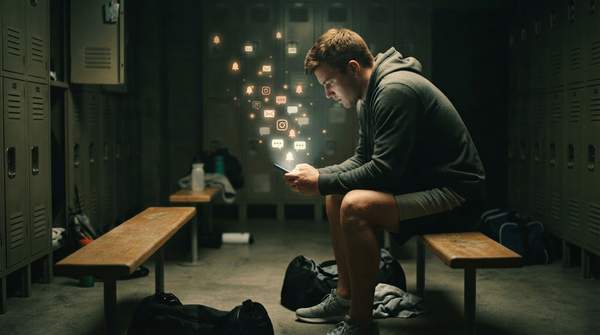
Social media is neither a straightforward hazard nor a harmless promotional tool for athletes. According to research syntheses in sport psychology, it operates as a genuine double-edged sword: the same platforms that let athletes build personal brands, connect with fans, and attract opportunities also expose them to constant public judgment, social comparison, and online abuse. Athletes, this research suggests, are a uniquely vulnerable population because they already operate in performance-oriented environments where evaluation, scrutiny, and identity formation collide with unprecedented digital visibility.
The Double-Edged Sword: Social Media's Dual Impact on Athletes
The central finding across the published research is that social media's psychological impact on athletes cannot be reduced to a simple good-versus-bad verdict. A paper examining the relationship between social media, athlete identity, and performance concludes that while these platforms give athletes "an unprecedented platform to express themselves and grow their brands, it can also serve as a double-edged sword."
The same mechanism that creates the benefit creates the risk. Direct audience access allows athletes to craft personal narratives that extend beyond their statistics, but it also means those audiences can respond instantly, publicly, and sometimes viciously. A systematic review of the field published in Frontiers in Sports and Active Living frames the relationship as conditional: excessive or dysregulated use may exacerbate vulnerabilities that already exist in athletic environments, while some forms of engagement may even be associated with improved self-esteem or reduced distress under specific contextual conditions. The tone of the impact, in other words, depends on how the engagement is structured.
Building a Brand and Connecting with Fans: Positive Pathways
Two distinct positive mechanisms recur in the research. The first is personal branding. Platforms such as Instagram, X, and TikTok allow athletes to engage directly with audiences, creating narratives that go beyond match results and opening doors to recognition and opportunity. As clinical counselor Adrienne Sabo puts it, social media lets athletes "share highlights, celebrate wins, connect with teammates, promote accomplishments, and build a personal brand," and for some it becomes a genuine source of support.
The second pathway is fan connection. Direct athlete-fan interaction can build stronger loyalty and a sense of community, and an editorial on technology and social media in sport notes that platform engagement offers opportunities for "positive interactions, community building, and the promotion of socially responsible ideas." These are not trivial benefits: belonging and perceived support are psychologically meaningful, particularly in careers defined by short professional lifespans and frequent relocation.
Both pathways, however, depend on the same feature that fuels the negative ones — visibility. The athlete who cultivates a following is also the athlete exposed to that following's judgment. Understanding this shared root is what turns a list of pros and cons into an explanatory model.
The Athlete's Digital Arena: Opportunities and Risks
The framework below organizes the documented effects of athlete social media engagement into the two pathways researchers identify, separating the opportunity mechanisms from the risk mechanisms that grow from the same root of public visibility.
| Pathway | Documented effect | What conditions it |
|---|---|---|
| Positive: Personal branding and commercial opportunity | Athletes control their image and build narratives beyond sport performance, creating potential opportunities. | Enabled by direct engagement with audiences and sharing aspects of their lives. |
| Positive: Direct fan engagement and support | Community building, positive interactions, and a sense of connection with fans. | Can promote socially responsible ideas and build a loyal following. |
| Negative: Public scrutiny and performance pressure | Increased pressure from athletic expectations and constant fan judgment, with heightened anxiety and stress about athletic image. | Increases emotional vulnerability; athletes may base self-perception on external approval. |
| Negative: Social comparison | Exposure to comparison processes, especially appearance-based comparison, that can exacerbate existing psychological vulnerabilities. | Heightened by the inherent nature of athletic competition and public visibility. |
| Negative: Online abuse and harassment | Negative comments, cyberbullying, and toxic fan interactions that threaten emotional integrity and well-being. | Awareness and mitigation strategies are needed; biases tied to race, gender, and sexual orientation appear in the abuse athletes receive. |
The value of this framework is diagnostic rather than moral. It shows that branding success and emotional harm are not opposite choices — an athlete can be building a thriving brand and simultaneously absorbing harassment through the same account. The question for athletes and their support networks is which pathway a given pattern of use feeds, and under what conditions.
Why Athletes Are Uniquely Vulnerable to Social Media Pressures
The research repeatedly identifies athletes as a distinct population rather than a variant of general social media users. The reasoning is structural: athletes already operate in performance-oriented environments where their worth is publicly and continuously evaluated. Social media does not introduce evaluation into these lives — it multiplies it, layering constant fan judgment and athletic-image anxiety on top of existing competitive pressure.
The digitalization of fan culture intensifies this vulnerability. Research on athlete-fan relations describes how the relationship between the two groups "has become both closer and more fragile": echo chambers among fans intensify polarization and cancel culture, amplifying psychosocial pressure on the athlete and turning feedback channels into conduits for toxic interaction.
Young athletes face an additional developmental layer. Writing on how social media is changing the game for athletes, Elyse Gorrell of The Conversation notes that for youth athletes, athletic identity becomes a major part of forming a sense of self — shaping how they think, feel, and relate to others through sport — precisely during the developmental window when social media use is heaviest. Excessive or problematic use during this period, she reports, can increase the risk of depression, low self-esteem, harassment, and burnout. Identity formation, athletic self-concept, and algorithmic feedback thus arrive at the same time.
Finally, the abuse itself is unevenly distributed. Sports medicine commentary from UC Davis Health highlights that the negative impacts athletes absorb carry racial, ethnic, gender, and sexual-orientation biases — meaning visibility multiplies pressure unevenly across the athlete population rather than uniformly.
What the Research Can and Cannot Tell Us
An honest reading of this literature requires distinguishing what is established from what remains open. The systematic review positions many findings as associations — some forms of engagement "may be associated with" improved self-esteem, excessive use "may exacerbate" existing vulnerabilities — rather than demonstrated causal effects. Social comparison, particularly appearance-based comparison, emerged in that review as a central candidate mechanism, but candidate mechanisms are not confirmed pathways.
The sport-psychology editorial likewise avoids causal claims, stating that engagement on these platforms "can also lead to" negative impacts on well-being and psychological functioning, and explicitly calls for continued research to better inform athletes, coaches, teams, and mental health professionals about best practices. The recurring limitations across this field are the prevalence of cross-sectional designs, which cannot establish direction of effect, and the shortage of longitudinal and intervention-based studies that would test whether changing how athletes engage actually changes their outcomes.
Navigating the Digital Arena: A Call for Proactive Support
Athletes and their support networks must adopt proactive, strategic, and protective approaches to social media engagement to maximize benefits while mitigating significant mental health risks. The evidence points toward organizational responsibility rather than purely individual coping: commentary from within the sports industry notes that specialist external agencies are already introducing support, advice, and techniques for dealing with damaging online behaviors, but argues this needs to become a full-time service offered by employers to employees if the risks of abuse and misuse are to be mitigated.
The measurable indicator to watch is the increased implementation and evaluation of tailored social media training programs and integrated mental health support systems within sports organizations. This is currently a call for future action rather than a documented outcome — but it is the concrete next milestone the research points toward, and the standard against which progress in this field can reasonably be judged.
Sources
- Frontiers | The impact of social media on athletes' mental health: a systematic review
- Social Media and Athlete Mental Health: The Pressure Behind the Posts - Insight Counseling — Insight Counseling - Just another WordPress site
- Editorial: The role of technology and social media in sport - PMC
- Protecting athletes’ mental health from social media risks — news
- How social media is changing the game for athletes — The Conversation