Biomechanics answers a simple question with hard instrumentation: what forces does a sport put on the human body, and where do those forces do damage? In extreme sports, where athletes contend with wind, water and equipment simultaneously, that question becomes urgent. A research paper on kite surfing shows how the discipline works in practice, documenting injury rates of 7.0 per 1000 hours of riding, rising to 16.6 during competitions, and a high incidence of lower back muscular strain.
Introduction to Biomechanics in Extreme Sports
Sports biomechanics is the study of athletic movement as a mechanical system—forces, joints, muscle actions and their measurable consequences. Its twin goals are performance optimization and injury reduction, and its subject matter is unusually demanding in extreme sports, where the environment is unpredictable and the forces on the body are large and constantly changing. The kite surfing study poses the framing question directly: do extreme sports contribute to higher biomechanical stress compared to other sports? To answer it, the researchers combined surveys with biomechanical measurements, mapping both injury patterns and the mechanical stresses on the musculoskeletal system during riding. That combination—asking what the body endures, then measuring it—is the essence of the discipline.
Core Questions of Biomechanical Analysis
Before any sensor is attached, biomechanical analysis begins with a structured set of questions. The National Strength and Conditioning Association's guidance for practitioners identifies four: What are the patterns of movement—concentric, eccentric, or isometric—and in which planes do they take place? What joints are involved during the activity? What muscles are recruited, and what are the muscle actions? And what is the duration of time the athlete is actively engaged in the event?
Answering these requires choosing the right measurement setting. As clinical references on sport biomechanics explain, testing can be done in the lab or in the field, during training or competition, and the type of sport determines the procedures. Three-dimensional motion analysis captures complex processes the human eye cannot observe, while wearable accelerometers and gyroscopes provide real-time biomechanical data that can inform injury prevention strategies. The coach, clinician and athlete all belong in the problem-solving process, because the issue to be addressed must be defined before it can be measured.
Case Study: Biomechanics of Kite Surfing
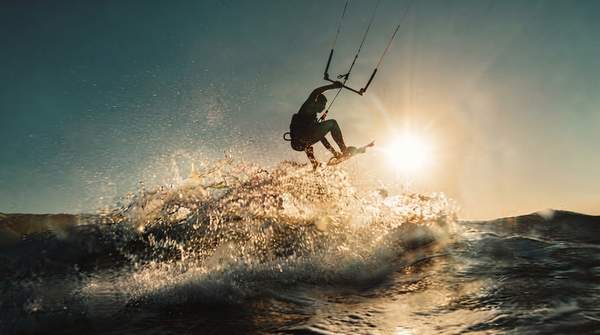
Kite surfing makes an ideal case study because nearly every variable in the four-question framework is extreme. The rider is pulled across water by a kite whose force changes with every gust, requiring dynamic, full-body movement under constantly varying environmental conditions. The study's biomechanical measurements were designed to map exactly this: dynamic forces acting on the body, along with pitch and roll—the tilting motions of the rider and board as they interact with wind and water.
The research combined survey data with these measurements to build a picture of the sport's demands on the musculoskeletal system. Equipment choices matter too: the study noted that the choice of kite type was mainly based on the respondent's riding discipline, meaning the mechanical loads a rider experiences are partly a function of equipment configuration. This is where the abstract framework becomes concrete—each analytical question (movement patterns, joints, muscles, duration) maps onto a measurable physical reality on the water.
Biomechanical Analysis Framework: Kite Surfing Case Study
The table below traces how biomechanical inquiry moves from a general analytical question to a specific finding in kite surfing. Read each row left to right: the question a sports scientist asks, the principle behind it, how it is measured, and what the kite surfing research found.
| Analytical Question | Biomechanical Principle | Measurement Method | Kite Surfing Application |
|---|---|---|---|
| What are the movement patterns (concentric, eccentric, isometric) and their planes? | Analyzing the entire sequence of competition reveals the sport's demands and muscular actions involved. | Lab or field testing; three-dimensional motion analysis; wearable accelerometers and gyroscopes giving real-time data. | Dynamic, full-body movement under varying environmental conditions, requiring analysis of pitch, roll and dynamic forces. |
| Which joints face the most intense muscular actions, and which muscles are recruited? | Identifying key anatomical structures is essential for injury prevention and performance optimization; intense exertion can be isometric, holding a joint against external stress. | Survey and injury mapping combined with biomechanical measurement of musculoskeletal stress. | Significant stress on the musculoskeletal system, with a high incidence of lower back muscular strain. |
| How are forces and motion quantified during the activity? | The type of sport determines the testing procedures; the coach, clinician and athlete define the problem to be measured. | Force mapping, inertial sensors, and motion analysis—chosen according to the sport and skills analyzed. | Research maps dynamic forces, pitch and roll to quantify stresses on the body during riding. |
| What is the injury risk profile of the activity? | Measurement exists to mitigate identified risk, not merely describe it. | Combined survey and biomechanical measurement of injuries and stresses. | Injury rates of 7.0 per 1000 hours, and 16.6 during competitions; trauma injuries often linked to inadequate safety systems such as quick releases. |
The framework's value is visible in the progression: a broad question about movement becomes a measurement plan, and the measurement plan produces a specific, actionable finding—lower back strain as a prevalent injury, identified through force mapping and motion analysis.
Common Injury Patterns and Risks in Kite Surfing
The study's injury findings are specific and sobering. Kite surfing carries an injury rate of 7.0 per 1000 hours of activity, and that rate is 16.6 per 1000 hours during competitions. Trauma injuries dominate, and the research links many of them to inadequate safety systems—particularly quick releases, the mechanisms that should detach a rider from a kite that has become dangerous. Alongside acute trauma, the biomechanical measurements point to overuse-type stress: a high incidence of muscle and tendon strain, with lower back muscular strain the most prevalent pattern. These figures are specific to kite surfing and reported per 1000 hours, with a clear distinction between general riding and competition. The pattern makes biomechanical sense: sustained, isometric-style resistance to kite forces transmitted through the trunk loads the lower back repeatedly across a session.
Informing Training and Injury Prevention in Extreme Sports
The practical payoff of all this measurement is program design. The NSCA guidance is explicit that the four analytical questions exist so strength and conditioning professionals can determine the demands placed on the body during a sport—and then select exercises and build training around those demands. A sport-specific review published under the theme "Biomechanics and Sports Performances" describes the same logic from the technology side: research there examines training programs and new monitoring technologies that track the biomechanics of specific technical gestures in order to improve performance and reduce injury risk. Field measurement tools such as pressure insoles and inertial sensors make it possible to collect data in the actual sporting environment rather than only in a lab.
Athletes and coaches in extreme sports should integrate biomechanical analysis findings to tailor training programs, focusing on mitigating specific injury risks identified through research. For kite surfers, that means training designed around the documented stresses—dynamic forces, pitch and roll, and the lower back strain they produce—rather than generic conditioning. This article describes injuries found in research; it is not medical advice, and it does not prescribe a specific training plan. The measurable indicator of success is a reduction in the reported incidence of specific injuries, such as lower back strain in kite surfers, following the implementation of biomechanically informed training protocols.